The Meter Test: Are You Buying Outcomes or Renting Tokens?
Token resellers bill units of their own cost. Outcome sellers bill units of your work. Five questions that reveal which kind of AI vendor you are signing with.
Two AI vendors land in your inbox the same week. Similar demos, similar promises, similar price tags. But look at the invoices they'll eventually send you.
One reads: "2.4M credits consumed."
The other reads: "312 analyses delivered."
Same models underneath, but completely different businesses, and completely different deals for you.
I think this difference is the most useful thing a buyer can understand about the AI market right now, and not everyone evaluates vendors on it. We compare features, benchmarks, security questionnaires. We rarely ask the question that determines what the relationship looks like in month eight: what is the unit on the invoice, and whose problem does it describe?

Token resellers and outcome sellers
Here's the split I keep seeing.
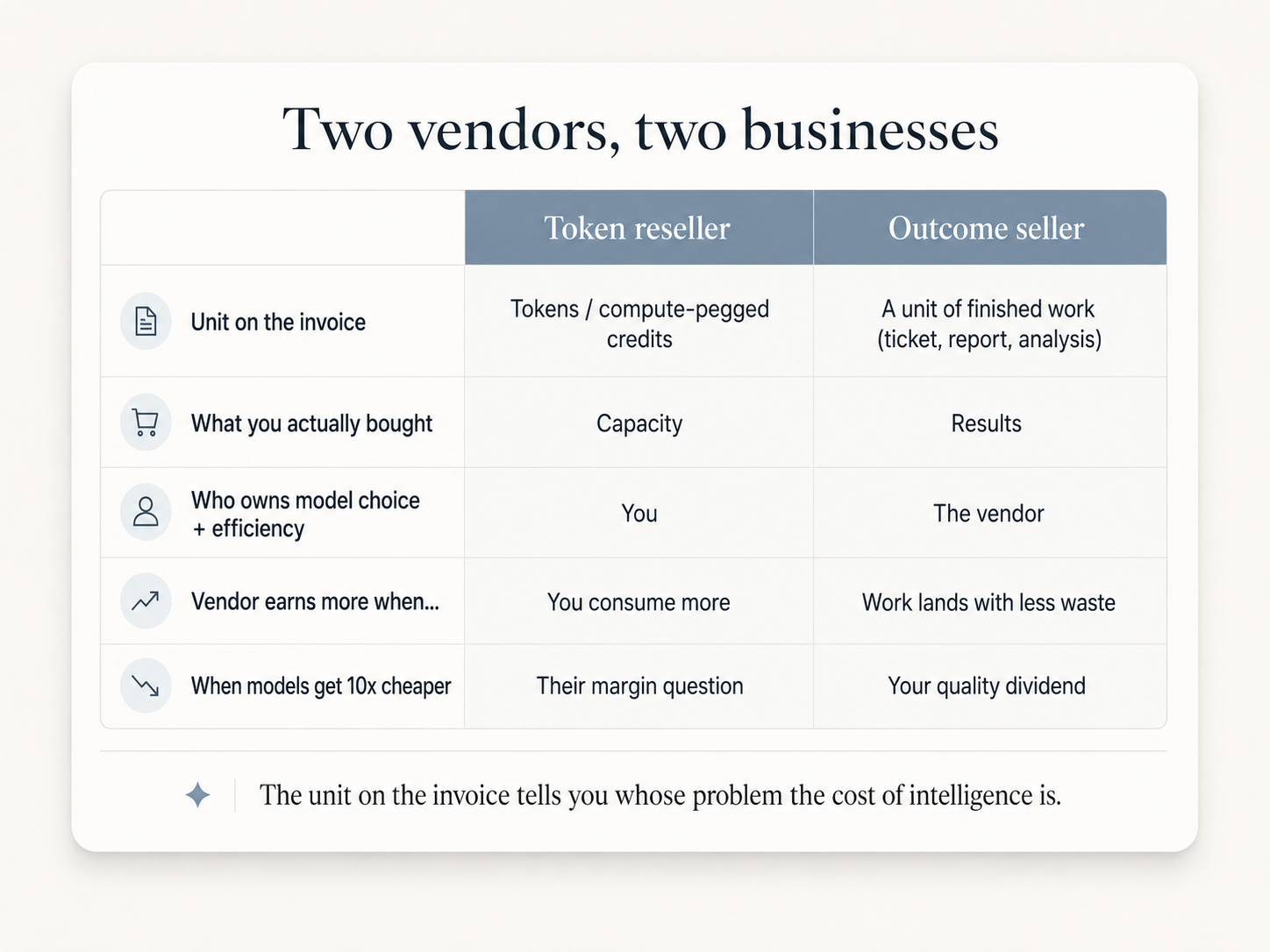
A token reseller sells you somebody else's intelligence with a margin on top. They've built a workbench (agents, skills, a nice interface) and underneath it, frontier models or open source models do the thinking. The unit they bill you is a unit of their cost: tokens, or credits pegged more or less directly to compute. Making the intelligence useful is your job. Deciding which model to use, how hard it should think, whether the output was worth it: your job. They clip the ticket on the flow.
An outcome seller sells you a unit of finished work your business already recognizes: a resolved support ticket, a drafted contract, a completed analysis, a business case. The gap between what intelligence costs and what the work is worth is their problem, and so are model choice, context engineering, quality bar, and efficiency. You pay for the thing you actually wanted.
To be clear about what this framing is not: selling tokens is not a scam and it's not lazy engineering. For actual infrastructure, for model APIs and inference platforms, cost-denominated pricing is honest and correct. If you sell infrastructure, sell tokens proudly. The problem is applications priced like infrastructure: the vendor built a workflow product but bills like a cloud provider, which quietly hands you their homework.
Sarah Tavel wrote the founder-side version of this back in 2023: sell work, not software. In founder circles, I hear constant echoes of that debate. What I haven't seen much of is the same idea written for the people signing the contracts.
How we got here: the free lunch and the repricing
For about two years, most AI products were priced like the tokens didn't exist. Flat subscription, unlimited usage, growth first, unit economics later. It was easy.
Then agents happened. An agentic workflow doesn't consume tokens like a chat window: it consumes 5 to 30 times more per task, and enterprise consumption estimates have been running 40 to 70 percent below actual burn once agentic features switch on. The bill arrived and the market repriced in public.
The clearest example was the AI coding category in mid-2025. Cursor moved from effectively unlimited usage to metered credit pools, the backlash was immediate, and the company apologized within weeks for how it was communicated. Copilot, Windsurf and others made similar moves in the same window. Within months, an entire category went from "don't worry about it" to "watch the meter."
I don't think these vendors got greedy. I think they got caught: they had been selling outcome-shaped promises on token-shaped economics, and when real usage arrived, the meter came out. Which means their customers discovered mid-contract which kind of vendor they had actually signed with.
That's the practical stake here. You want to know before you sign, not at the repricing email.
What the customer actually experiences
The unit on the invoice isn't an accounting detail. It sets three things you'll live with every day.
1. Your vendor's incentives
A token reseller earns more when your people consume more. Think of a support bot that gets paid per token: it is structurally incentivized to write the longest answer, not the best one. An outcome seller earns more when the work lands, and eats the cost when it doesn't. One vendor profits from your inefficiency. The other one absorbs it.
2. Your governance burden
When intelligence is free at the point of use, nobody orders the house wine. Picture an analyst running the most expensive frontier model at maximum reasoning effort to summarize a meeting invite, not because they're careless, but because the menu has no prices, so why would anyone order anything but the best? Multiply by a thousand employees.
This is the open-bar problem, and it ends the same way every open bar ends: a cap, a lockout, and a hangover. The public receipts are piling up, from enterprises burning their annual AI budget in four months and imposing per-person spending caps, to teams discovering a trillion tokens of unplanned consumption. Sentiment inside these companies swings from "coolest thing we've ever deployed" to "kill it" within a quarter or two, and the tool didn't get any worse. The pricing model just outsourced governance to the customer, and the customer found out from the invoice.
3. Your actual scope of work
This is the one that gets missed in procurement. With a token reseller, what you bought is capacity. The prompting, the model selection, the evaluation, the cost optimization: that whole layer is now an unbudgeted job on your side, and it usually lands on your best people.
With an outcome seller, that layer is the vendor's job, and not out of generosity. Their margin depends on doing it well. They route the simple tasks to small models and the hard ones to frontier models, they tune the context, they hold a quality bar, because every bit of waste comes out of their pocket instead of yours.
The hard, unglamorous optimization work doesn't disappear in either model. The only question is which side of the contract it lives on.
This movie has played before
In 1962, Rolls-Royce noticed that airlines didn't want to buy jet engines. They wanted thrust, reliably, at a predictable cost. So Rolls-Royce started selling "Power by the Hour": a fixed rate per flying hour, with the manufacturer owning maintenance, spare parts, and reliability risk. The strategic move is discussed in business schools, and I think it's worth studying again in this transition.
The unit moved from inputs (engines, parts, labor) to outcomes (hours in the air). And everything downstream changed. Rolls-Royce got paid for reliability, so it invested in reliability. Contracts stretched from years into decades. Today the service side of that business out-earns the engines themselves.
Tokens are spare parts. Nobody wants tokens, the same way no airline ever wanted a crate of turbine blades. They want the ticket resolved, the analysis done, the business case written. In an almost ironic way, a sixty-year-old pricing model from aerospace turns out to be, arguably, the most modern pricing idea in AI right now.
The asymmetry that will decide the market
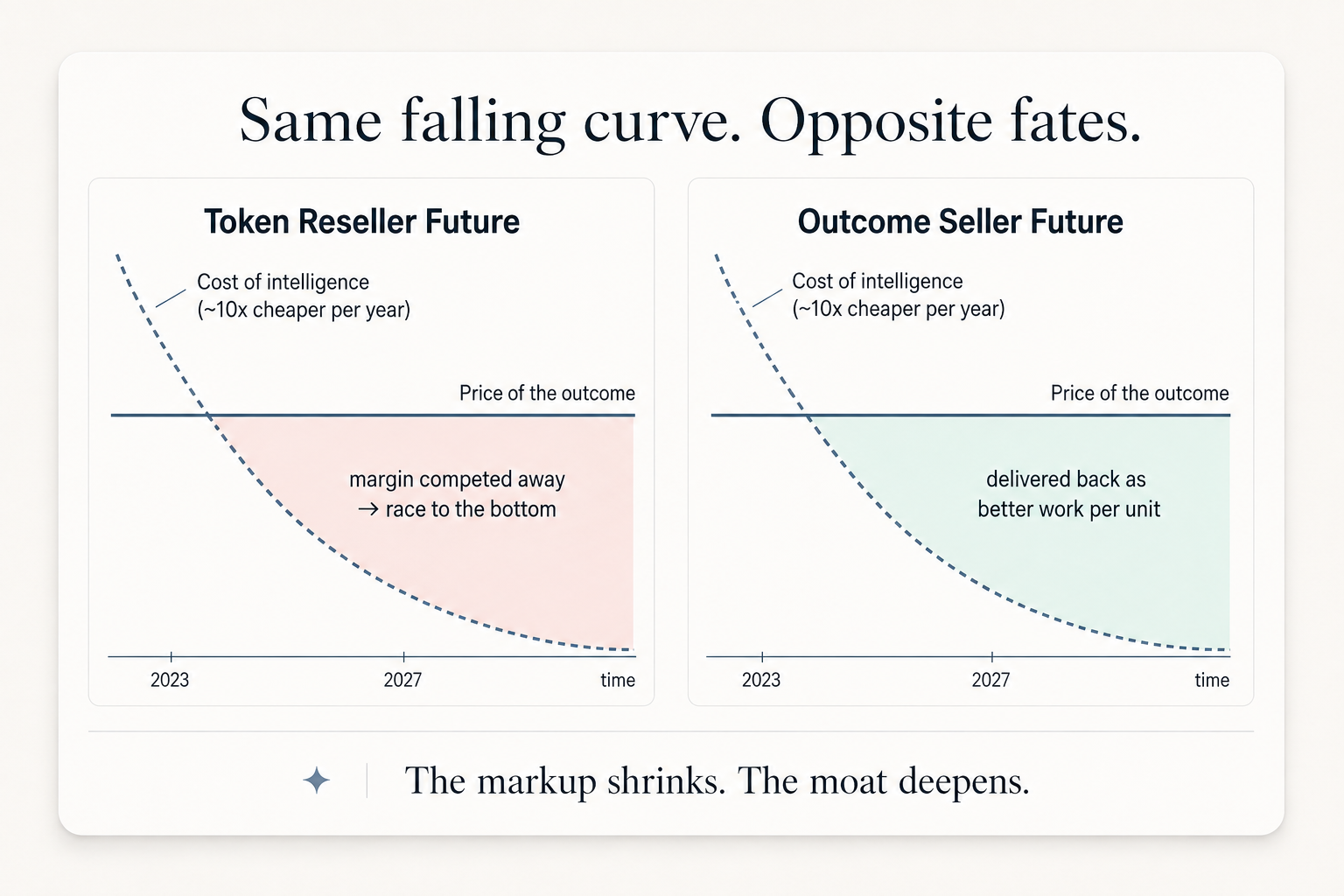
Here's the part I find gets too little attention outside technical forums. Intelligence is deflating faster than any input in the history of software. Frontier-class output that cost around $20 per million tokens in late 2022 costs well under a dollar today, roughly a 10x decline per year, compounding.
That trend lands completely differently on the two sides of this split.
For a token reseller, deflation is an existential problem. Their margin is a markup on a commodity in freefall, and every competitor can undercut them on infrastructure that neither of them built. The founder of one AI company, after publishing his own $217K quarterly compute bill, put it more bluntly than I would have: "You did not build the intelligence. You are just the pipe it flows through. And once you become a pipe, you can be replaced by a cheaper pipe."
For an outcome seller, deflation is an obligation, and I mean that as the good news. When the underlying cost of intelligence drops 10x, the price of the outcome doesn't need to move, but what the customer gets for it absolutely should: better models, more thorough work, higher quality per unit, delivered inside the same credit. Any outcome seller tempted to quietly pocket the difference will lose to the competitor who passes it on as quality. That's the competitive check built into the model. The vendor is permanently accountable for making each unit of work better, because the falling cost curve makes "better every year at the same price" the baseline expectation rather than a stretch goal.
So the same market force sorts the two models into opposite fates. A markup on a deflating commodity erodes toward zero. Accountability for an outcome compounds, because every new model generation is another chance to over-deliver on the same promise.
The markup shrinks. The moat deepens. Pick which side of that you want your vendors on. And if you sell AI software or services, put the question in front of your leadership team.
Where the limits are
I wouldn't want to claim that pure outcome pricing works everywhere. There are real limitations.
Attribution is hard. Fin, the support agent Intercom built, can charge $0.99 per resolution because it sits inside the help desk and sees the whole conversation, so it can define and measure the outcome. Most vendors don't have that vantage point. And outcomes have to be measurable, reasonably uniform, and finite for the model to work at all. "A resolved ticket" qualifies. "Good strategy" does not.
There's also a fair counterargument that deflation eventually reaches the work itself. If the outcome commoditizes, its price falls too, which is why serious outcome sellers gravitate toward work that's heavy on judgment, integration, and accountability rather than volume.
I lead the product and engineering effort for an AI product and have sat through plenty of pricing conversations. The unit question is the one we kept coming back to, and it is genuinely hard. So in practice, the market is landing on a spectrum, and most credible application vendors sit in the middle: work-denominated units. Credits, yes, but pegged to things your business recognizes (a document, an analysis, a review), with the vendor owning efficiency inside the unit.
That's the refined version of the test. A meter isn't the red flag; some meter is honest and fine. The red flag is what the meter counts: units of their cost, or units of your work.
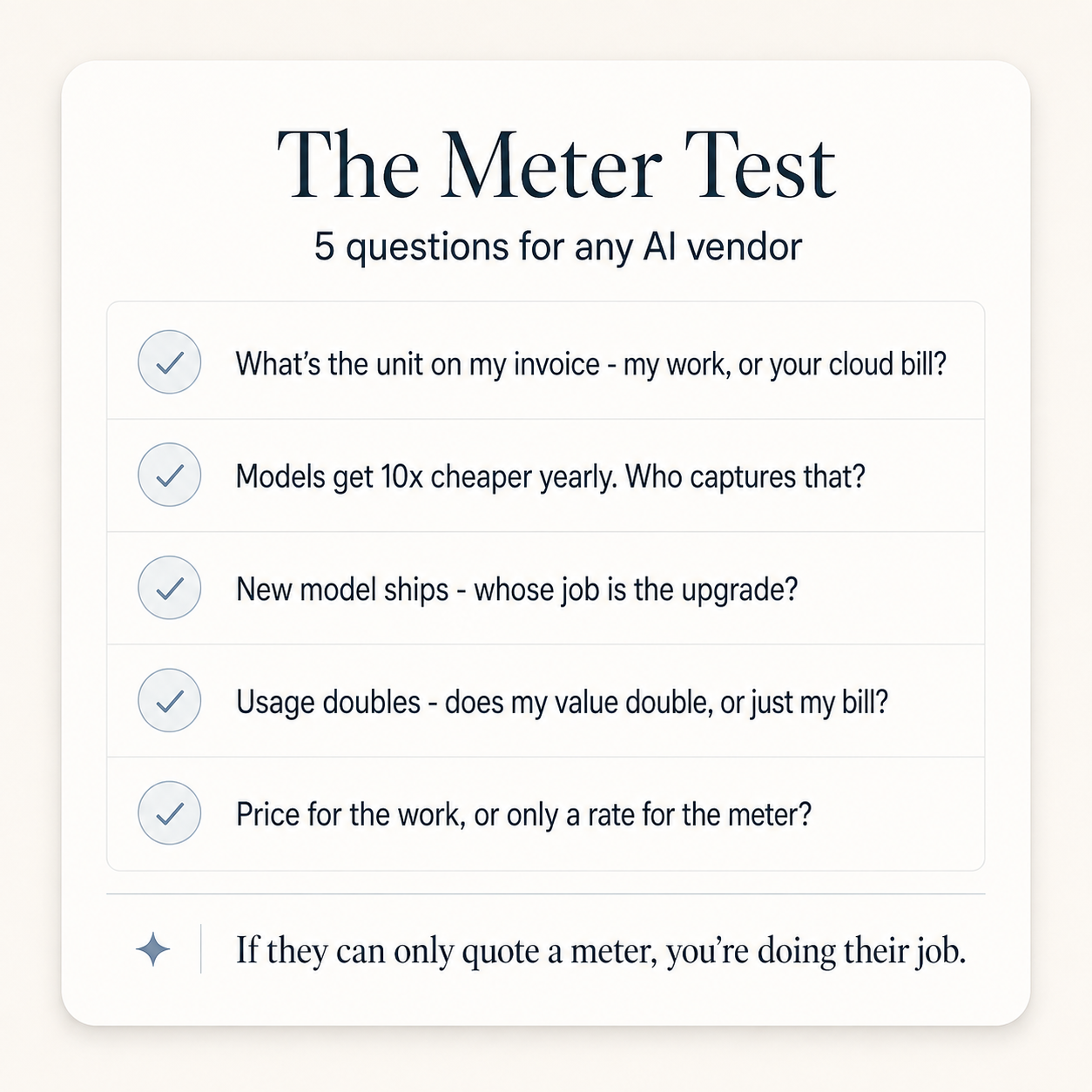
The Meter Test: five questions for any AI vendor
None of these questions are rude. A confident outcome seller enjoys them, and they are worth asking a token reseller too.
- What exactly is the unit on my invoice? Something my business recognizes (a resolution, a report, an analysis), or something only your cloud bill recognizes (tokens, compute-pegged credits)?
- Models get roughly 10x cheaper every year. Who captures that? Do I get more and better work per unit at the same price, or does your margin quietly improve while my bill stays flat?
- When a better model ships next quarter, whose job is the upgrade? Yours, invisibly, inside the unit? Or my team's, via a migration project and a pricing addendum?
- If my usage doubles, does my value double, or just my bill? Walk me through a concrete scenario.
- Can you quote me a price for the work, or only a rate for the meter? If you can't tell me what an outcome costs, you're asking me to underwrite your product decisions.
Where this goes
My guess is that a lot of AI pricing gets rewritten over the next couple of years. The coding tools repriced first simply because their usage got heavy first. Now the same pressure is working its way through every category where agents are switching on, which is almost all of them.
Buyers who understand the split negotiate better contracts today and skip the mid-contract surprise tomorrow. Founders who understand it get to pick a side on purpose instead of drifting into reselling by default.
Ready to get started? Book a demo to see Minoa in action.